
 Syspirit

Moving to Dublin involves a whole lot of things. One of them became obvious as soon as I started going through job ads: cloud is everywhere over there. So I set myself a goal before leaving: get the AWS Solutions Architect Associate certification (SAA-C03).
I started loosely at the end of March, then let three weeks slip by without doing anything. I got serious about it in early May. A month later, I sat the exam.
What I want to cover here is my method and the tools I used to get there.
The resources
Nothing exotic on that front, I went with what most people recommend:
- Stéphane Maarek’s course on Udemy for the theory. Genuinely the reference for the SAA: he covers all the features, the concepts and a fair share of use cases. He can move fast on some points, which is exactly why Claude was there the whole way whenever I had a question. Maarek for the videos, Claude for the live tutor.
- Tutorials Dojo’s practice exams to train under real conditions.
A side note: it became clear pretty quickly that the course assumes a decent grounding in infrastructure and general IT. If you are truly starting from zero, go through a Foundational certification first, the Cloud Practitioner.
Nothing new so far. The difference came from what I built around it.
My notes: Obsidian + Claude
I keep all my notes in Obsidian (my “second brain”, synced across all my devices and pushed to a private git repo for versioning). My workflow during the course was to jot down every important concept, draw parallels with cases I had run into in previous jobs, the possibilities, my open questions…
But on re-reading, it was messy and went in every direction at once.
So I built my own Claude skill, extract-notes, which takes my raw notes and turns them into clean files: one note per AWS service, always the same structure (context, how it works, limits, comparison tables). With one strict rule I imposed on it: verify every figure or limit on the web before “correcting” my notes. Cloud knowledge goes stale fast, AWS moves its limits every month, and I did not want the AI teaching me nonsense with total confidence.
It also handles the questions I left scattered in the raw notes: it answers them, and confirms or corrects whatever I had misunderstood. That is usually where I find out whether I actually got it.
The result: at the end of every session I run the skill, and my messy notes become a real knowledge base, linked together. Zero friction, and I revise from clean material.
Custom mock exams
Claude’s other contribution: challenging me. Every now and then I would ask it to generate a mock exam, timed, but only on the categories I had already covered. It forced me to reactivate what I had written down and to spot my gaps.
That said, these generated exams stay a bonus. For serious practice, Tutorials Dojo’s exams remain the best thing out there. And I might as well say it, my first two came in at 32% and 35%. That is normal, it is what they are for, and it is exactly what showed me where to dig.
It is a formidable loop all the same: I learn, I take notes, Claude formats, Claude quizzes me, I fix what is wrong. Far more effective than passively re-reading a course.
The tracker
During my prep I never really knew where I stood, or what I should be working on first. And I like having something to lay it all out and give me stats.
So I asked Claude Code to build me a tracker I could host myself: persistence, all of it in a Docker container. In under 30 minutes it was ready to be fed.
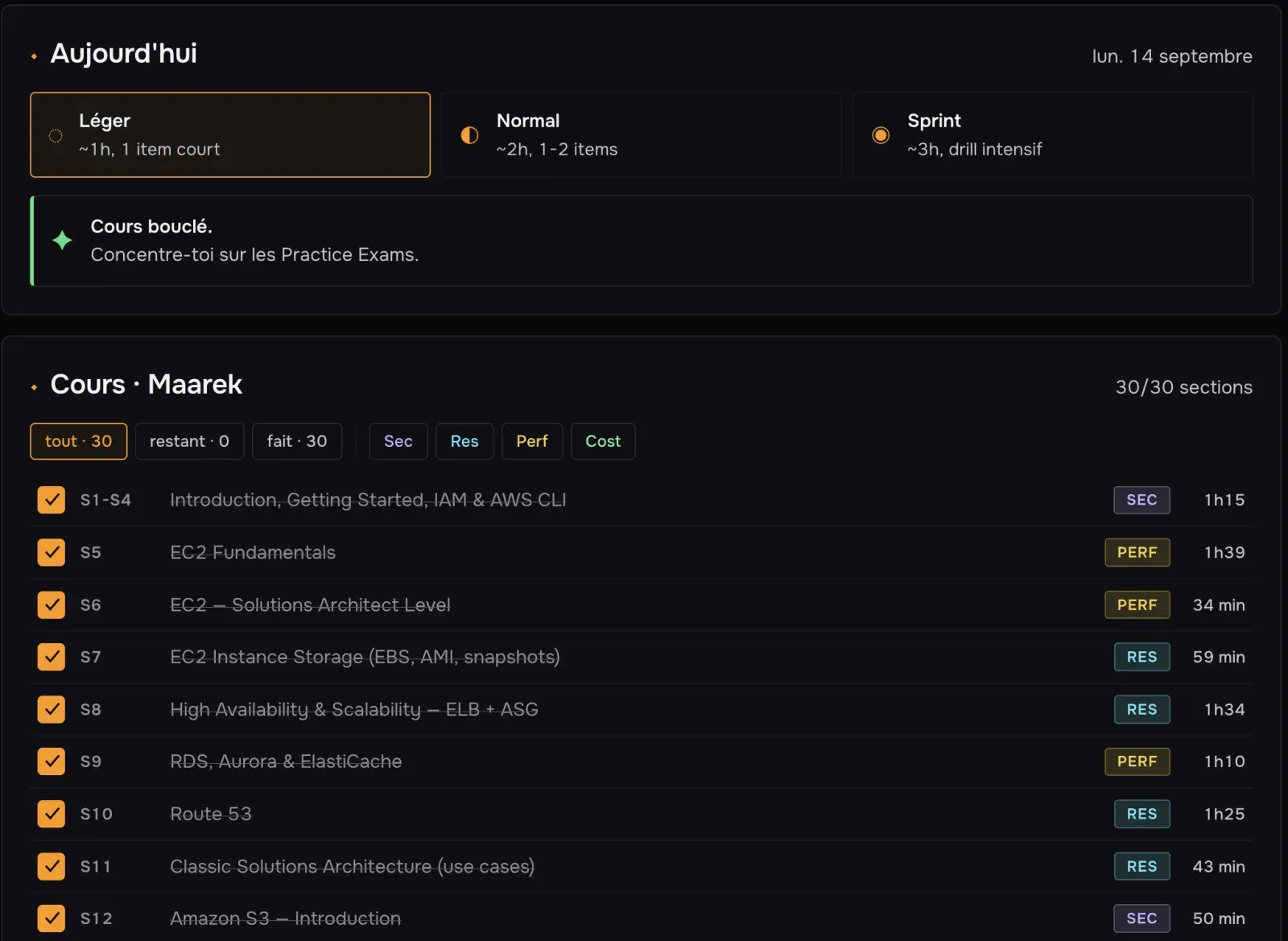
It tracks my course sections, my study time per day, my practice exam scores per domain, and it suggests what to revise based on how much energy I have that day (light, normal, sprint). The little extra that keeps you going: a Spotify-style “Wrapped” mode that sums up the whole run in charts.
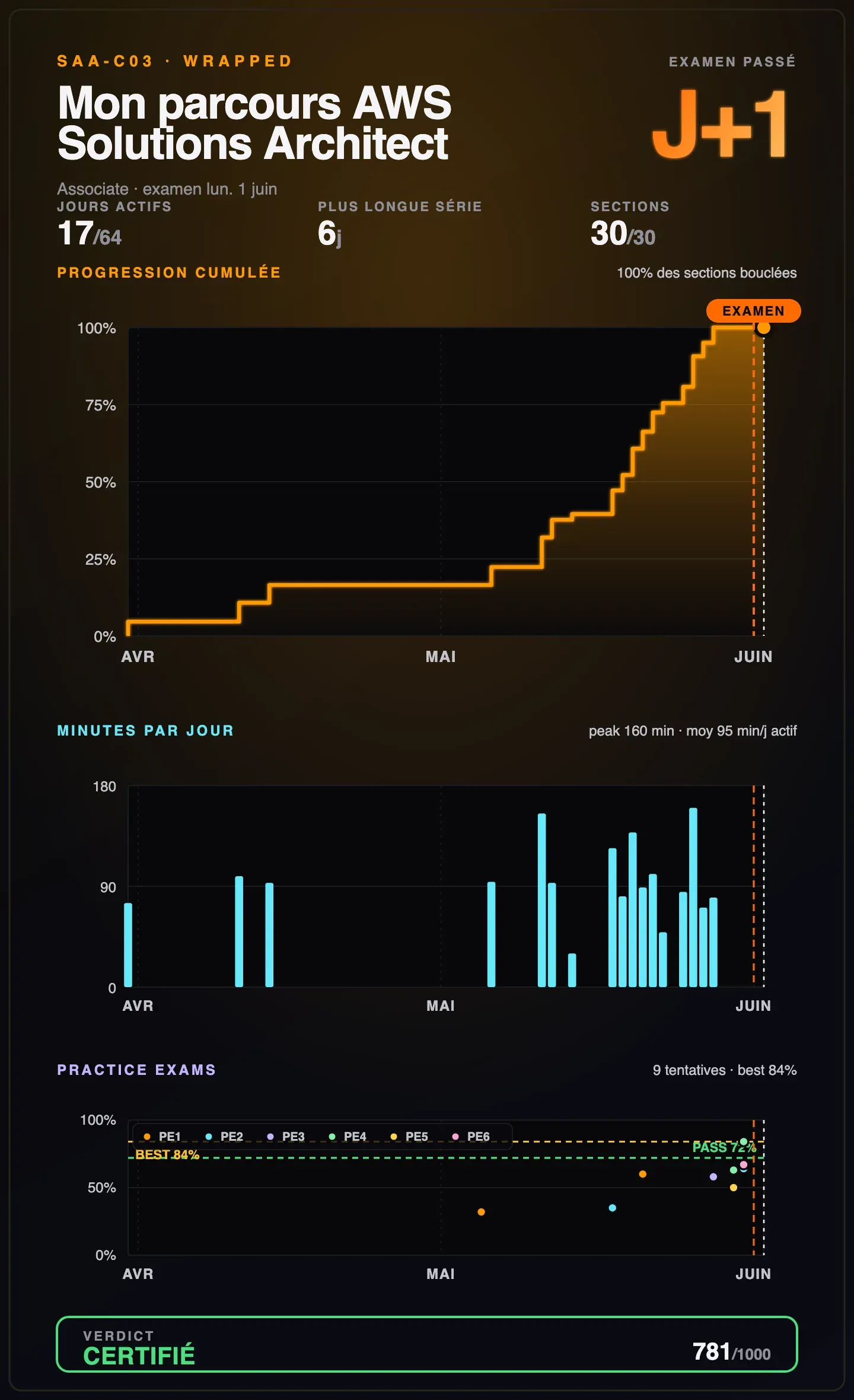
Far from perfect, but I would rather spend my time working on the cert than polishing a tracker 😅
Wrapping up
It was an intense month, and I am genuinely proud to have got the cert by figuring out my own workflow.

Looking back, I probably rushed it a bit: I may have skimmed over some concepts, and without practising daily I will inevitably forget a chunk of it.
Still, I have my notes, written my way, which will serve as memos if I ever end up working on AWS. I also plan to turn them into cheatsheets here.
If you are curious, I gathered everything I built during this prep into one repo: the tracker, the mock exams and both Claude skills. It is here.